.png)
.png)
The Fixer: How David Hirschfeld Built a Career Out of Solving Problems Nobody Else Could See
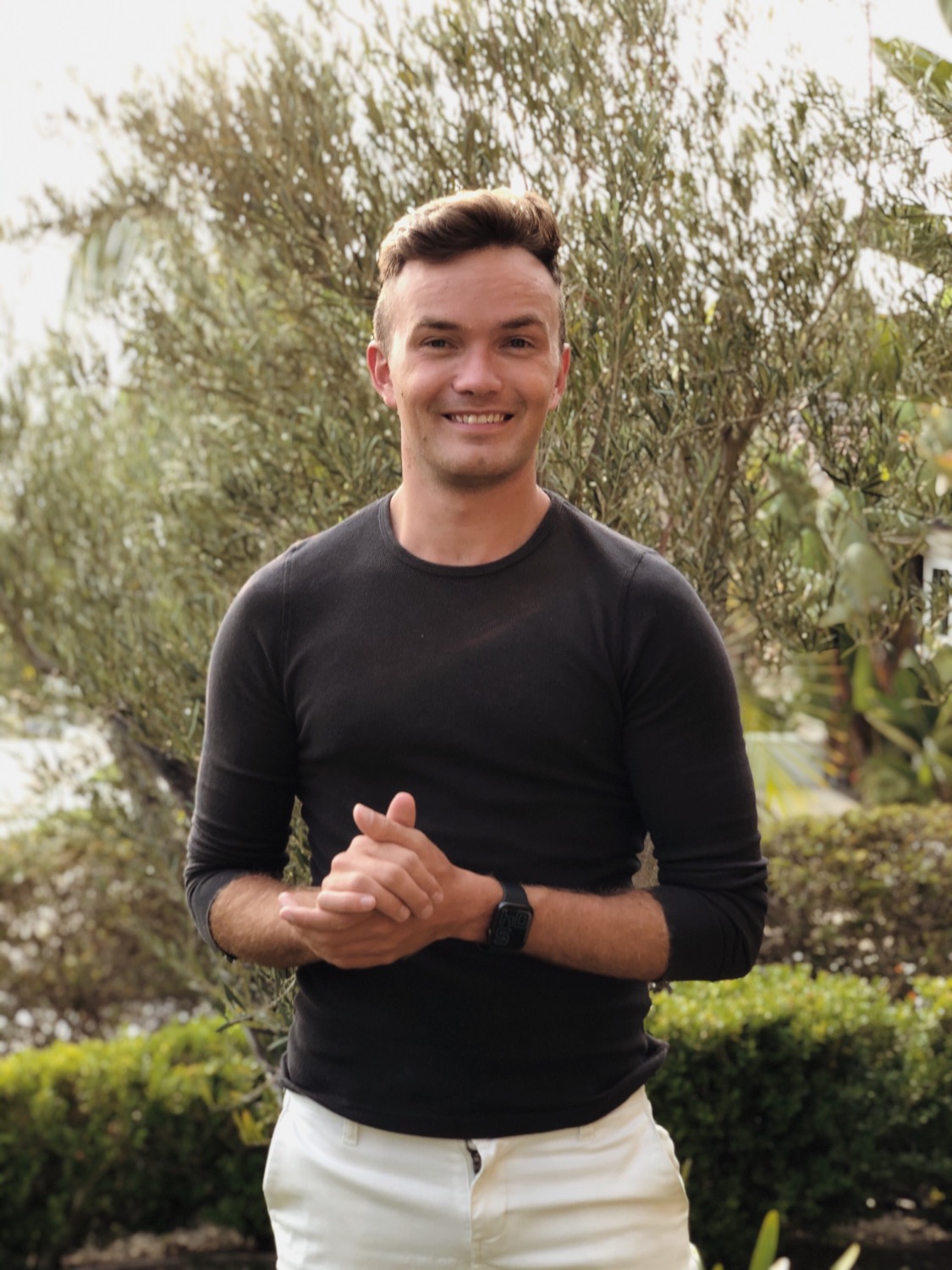
- Tim Holt
- Apr 28
- 8 min read
Built in San Diego | Tekyz, North County San Diego
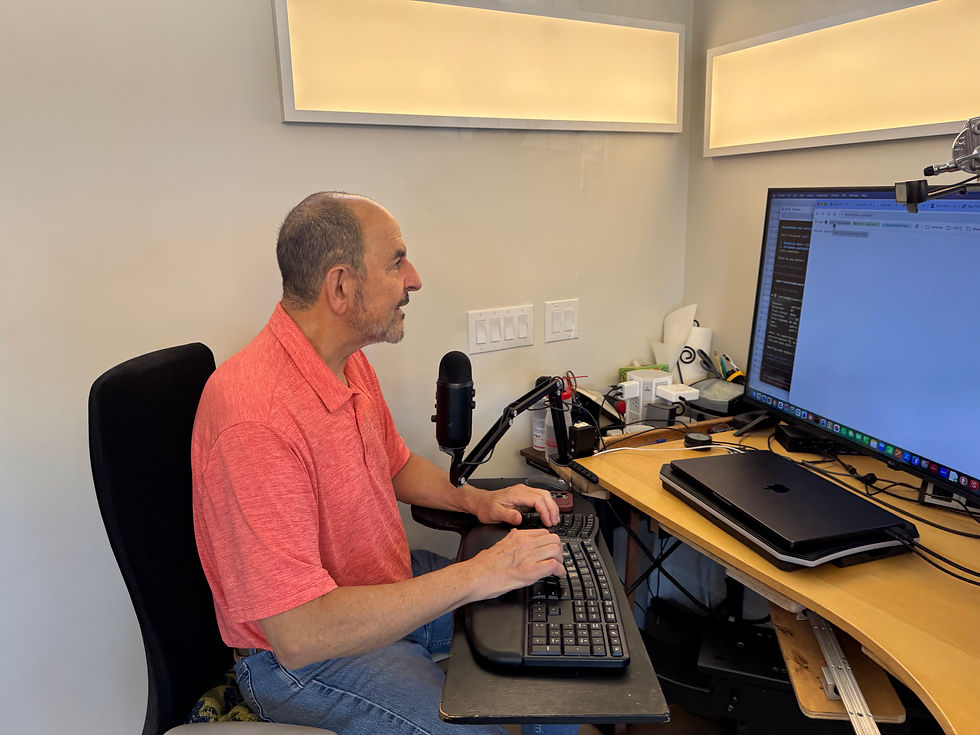
There is a moment, early in a conversation with David Hirschfeld, when you realize you are not talking to a typical software developer.

He is showing you his phone - not to demo an app he's selling, but to show you a prototype he built last week for himself. A waveform is pulsing on the screen, live, as he speaks. The app is identifying his voice in real time, separating it from ambient noise, tagging it with a confidence score, attributing it to a speaker profile.
He built it because he felt inefficient inputting people into his CRM when he was at live networking events. So he fixed the problem.
Then he mentions the audible tracker he built because he couldn't keep up with new releases in his favorite book series. And the AI-driven CRM he assembled last week because the ones on the market don't think the way he thinks. And the custom development environment he's spent months refining - a contract-driven, AI-orchestrated system that builds software the way he believes software should be built.
None of these tools exist commercially, at least not in the form David needed them. So he made them.
This is the central fact about David Hirschfeld: when he encounters a problem he can't solve with existing tools, he doesn't wait. He builds the tool. And after 35 years of doing exactly that - for himself, for startups, for scaling companies across industries - he has built something else too.
A reputation as one of the most quietly formidable software development minds in North County San Diego.
His company is called Tekyz. Their tagline is Hyper-Exceptional Development Team.
David did not choose that phrase lightly.
A Fixer From the Beginning
The story starts, as many great ones do, with a problem that needed solving.
It was the early 1990s. David's brother-in-law had left the military and started a vending machine business - a world of quarters and nickels, of inventory tracked across warehouses and trucks and hundreds of individual machines, each one a tiny store with its own velocity and its own rate of running out of things. The software available to manage all of this was built for enterprise budgets. His brother-in-law had a small operation and a real problem.
David, who had spent years in enterprise software development at Texas Instruments running projects for clients like Intel and Motorola, looked at the problem and saw a gap.
He built a solution - a Windows-based logistics system for the vending industry, one of the first of its kind built for small operators on affordable hardware.
"We put an ad in the trade magazine," he recalls, "and after the third time it ran, we started getting calls."
Then they went to a trade show - a tiny 10-by-10 booth in the back corner, dwarfed by the Coke and Pepsi installations. They couldn't eat lunch for three days. The line never stopped. They were demonstrating something nobody else had built: affordable, accessible software for an industry that desperately needed it.
They grew that company to 800 customers in 22 countries. They sold it in 2000.
It was his first exit. It would not be his last lesson.
What Failure Teaches You
The pattern of David's career is not an unbroken string of wins. It is something more useful - a series of experiments that taught him, with increasing clarity, exactly what makes a software company succeed or fail.
After the vending company sale, he started another venture in automotive wholesale trading. The idea was sound. The network he was building was promising. But he made a critical error: he wasn't charging for it. He was waiting for critical mass before monetizing, playing a social network playbook in a market that didn't reward patience.
"I didn't follow my first playbook," he says simply. "Just start selling it."
That failure - and the pattern he noticed across the dozens of startups he would later work with through Tekyz - eventually crystallized into a formal methodology he calls
Launch 1st™. The premise is almost counterintuitive: sell before you build. Generate revenue before you write a line of code. Use high-fidelity prototypes to validate that customers will actually pay for what you're proposing - before spending six figures discovering they won't.
"People that love their product, build something they think is going to be great - they fail almost every single time," David says, with the directness of someone who has watched this happen too many times to be diplomatic about it. "People that love the problem, and really want to talk to the customer about their problems - those are people that find a path to success."
It's a distinction that sounds simple. It almost never is. The pull of the product - the excitement of building, the seduction of features, the feedback loop of friends telling you it's brilliant - is powerful and nearly universal. David has learned to treat it as a warning sign.
The Company He Built to Build Things
Tekyz came together in 2007, initially as contract development work. What it has become over nearly two decades is something more intentional and more demanding: a hyper-exceptional development team, in David's own words, for clients who refuse to accept average.
The team is distributed - India, Portugal, the UK - assembled over years of deliberate relationship building. David made 15 trips to India between 2010 and the start of the pandemic, building not just a team but a culture. He was teaching something that didn't translate easily at first: fire fast.
"Don't try to carry people," he explains. "You send the wrong message to the rest of the team. You devalue everybody else by carrying somebody."
The result is a team with no junior members and no dead weight - senior developers who have passed a strict evaluation process and proven themselves in the first 30 days or been let go. The standard is unapologetically high. Smarter than you, or don't hire them.
What this team produces is evidence David is happy to put in front of any skeptic. Not promises - evidence. The invoicing system alone is unusual enough to merit mention: every invoice includes daily timesheets, broken down by individual contributor, by project, by task. If a client wants to audit six months of work, every hour is there: attributable, auditable, down to the quarter-hour.
"I hate the question, 'why did this person work that many hours this month?'" David says.
"I just look at the timesheet. I don't want them to ask me because they think I'm hiding something."
Nobody who has reviewed Tekyz's invoicing has ever asked.
Building in the Age of the 100-Foot Wave
David does not speak about AI the way most people in the technology world speak about AI. He doesn't speak about it as a future event or a distant disruption. He speaks about it the way a surfer speaks about a wave that is already here, already breaking, already demanding a decision: paddle hard or get wiped out.
He has built his own development environment around AI - a contract-driven system that plans, architects, documents, and manages software projects with a rigor that most human teams don't match. When Anthropic released a new Claude model last week, he didn't just update a setting. He kicked off a full analysis: what has changed, what in his framework needs updating, what assumptions need revisiting. An afternoon of work, multiplying across every future project the team builds.
The results are measurable. What used to take 60 days to develop - a minimum viable product that a client could actually use - now takes 15 to 16 days. Same quality. A fraction of the time.
The projects themselves reflect the moment. An AI coaching avatar for addiction
recovery - a system that holds natural conversations, understands the stages of the coaching process, learns where a specific person is in their journey, and holds them accountable over time. A dynamic health insurance guide that generates personalized explainer videos for each individual employee at enrollment time, walking them through their specific options and cost differences. A system now processing 8 million employees, with a recent contract from United Healthcare.
A referral partner network, built in under three and a half weeks. Typical timeline for similar work: three months.
The Problem He's Solving This Week
Somewhere in David's North County office, a prototype is running right now that doesn't yet exist as a commercial product anywhere in the world.
It listens. It transcribes in real time. It identifies individual speakers by voice print, even in a noisy room, even when people aren't introduced at the start. When a new voice appears in the feed, it captures it. When that voice introduces itself - "Hi, I'm Sarah" - the system locks the voice print to a name and retroactively attributes every previous utterance. Every three seconds, the audio is processed, scored, tagged.
The goal is elegant: David goes to a networking event, has three or four real conversations, never touches his phone, and leaves with a CRM record for every person he spoke with, a summary of what mattered, a suggested next step, and a set of referrals already queued for introduction. The system does the follow-up. It learns what works. It gets smarter.
He's testing a working version at the North County startup mixer this Tuesday.
The reason he's building it? He kept forgetting people's names. He kept losing track of promising conversations. He hated the friction between meeting someone interesting and actually doing something about it.
"I'm not doing this against my own problem," he says with a laugh. "I desperately need this for me."
This is the through line of David Hirschfeld's career, the thread that runs from the vending software he built for his brother-in-law to the AI development environment he's constantly refining to the voice-tagging prototype buzzing on his desk right now. He finds a problem. He looks for a solution. He builds the solution when none exists. And somewhere in the process, he figures out whether other people have the same problem - and whether they'll pay to have it solved.
It's worked for 35 years. He has no intention of stopping.
Who Should Call David
Tekyz is not the cheapest option on the market and David will tell you so directly. His team is senior, his process is rigorous, and his invoices are the most transparent in the industry. If you're looking for the lowest hourly rate, he will point you elsewhere without hard feelings.
But if you're a founder with a real problem you're living with every day - a problem you can't stop thinking about, a gap in your workflow or your industry that you know other people share - David Hirschfeld is the kind of person who will sit down with you, understand the problem before he talks about the solution, and tell you whether it's worth building before you spend a dollar on development.
He's also happy to just talk. You don't have to become a client.
"I'm happy to talk to anybody just to give them suggestions and advice," he says. "I don't need them to become a client."
That's a generous offer from someone who has spent 35 years learning exactly which problems are worth solving - and how to build the tools to solve them.

Tekyz tekyz.com info@tekyz.com
Tekyz is a custom software development company serving startups and scaling businesses with AI-driven development, workflow automation, and the Launch 1st™ methodology. This article is part of the Built in San Diego series by Revvia Marketing, featuring the stories of local business owners and the people building San Diego's business community one door at a time.
Interested in being featured? Contact Revvia at revvia.com


Comments